

What happens when your child needs a Child Protection Medical Assessment?
Please select the arrow below for further information, or click on the image to download the full information sheet.
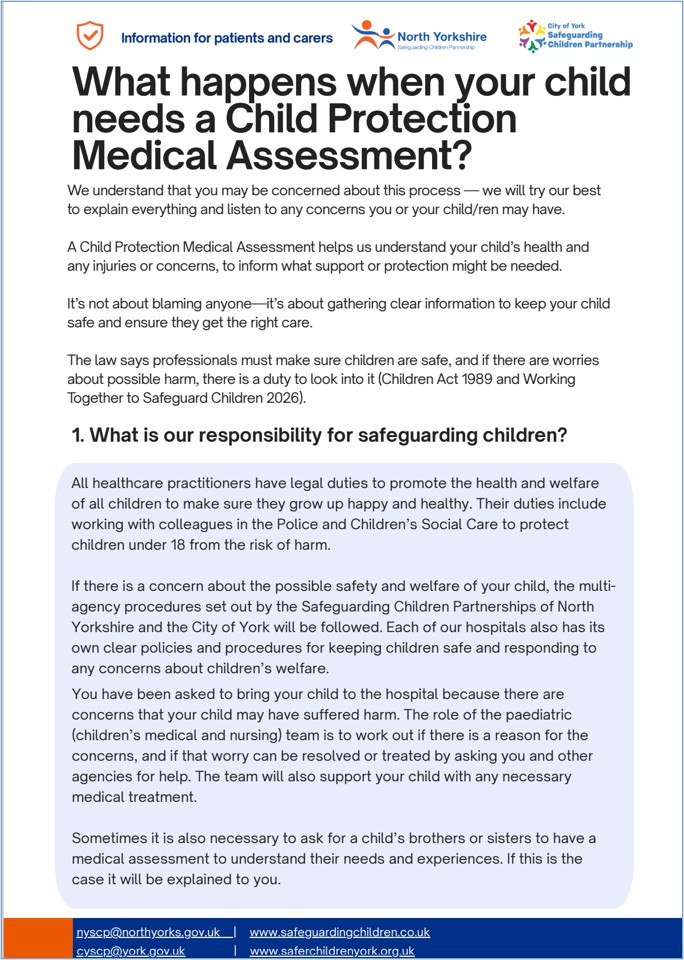
We understand that you may be concerned about this process – we will try our best to explain everything and listen to any concerns you or your child/ren may have.
A Child Protection Medical Assessment helps us understand your child’s health and any injuries or concerns, to inform what support or protection might be needed.
It’s not about blaming anyone—it’s about gathering clear information to keep your child safe and ensure they get the right care.
The law says professionals must make sure children are safe, and if there are worries about possible harm, there is a duty to look into it (Children Act 1989 and Working Together to Safeguard Children 2026).
1. What is our responsibility for safeguarding children?
All healthcare practitioners have legal duties to promote the health and welfare of all children to make sure they grow up happy and healthy. Their duties include working with colleagues in the Police and Children’s Social Care to protect children under 18 from the risk of harm.
If there is a concern about the possible safety and welfare of your child, the multi-agency procedures set out by the Safeguarding Children Partnerships of North Yorkshire and the City of York will be followed. Each of our hospitals also has its own clear policies and procedures for keeping children safe and responding to any concerns about children’s welfare.
You have been asked to bring your child to the hospital because there are concerns that your child may have suffered harm. The role of the paediatric (children’s medical and nursing) team is to work out if there is a reason for the concerns, and if that worry can be resolved or treated by asking you and other agencies for help. The team will also support your child with any necessary medical treatment.
Sometimes it is also necessary to ask for a child’s brothers or sisters to have a medical assessment to understand their needs and experiences. If this is the case it will be explained to you.
2. Working in partnership to safeguard your child
We understand that it is upsetting to have concerns raised about your child’s safety and wellbeing. The paediatric team and colleagues from other agencies will always try to work closely with parents and carers to offer support at this difficult time.
3. Consent
You will be asked to confirm that you have legal responsibility for your child, and then to agree (consent) to any medical assessments which may be necessary. The paediatric team will make sure you understand what is happening and why.
Some young people may be able to give this consent themselves, as long as the team completing the assessment believes the young person fully understands what is involved.
If you or your child feels unable to give consent for the Child Protection Medical Assessment, this will be discussed with colleagues in Children’s Social Care to agree on the way forward.
4. Child Protection Medical Assessments
A Child Protection Medical Assessment is completed to check for any signs of harm that may have happened to your child. An experienced children’s doctor will talk with you about what has happened and will complete a medical examination of your child, being sensitive to how your child is feeling. Another member of the team will be present during the examination to act as a chaperone.
Children’s Social Care are always informed when a Child Protection Medical Assessment is undertaken as they have a legal duty to look into any child protection concerns.
Your allocated Social Worker will be able to talk to you about the child protection process and any decisions which may need to be made about your child’s safety, including plans for discharge from the hospital.
Social workers work closely with police officers who specialise in safeguarding.
5. Medical investigations
These can include:
Blood and urine tests – these may be needed to look for any underlying medical causes for your child’s presentation. Sometimes it can take time for the results to be available as the samples may need to be sent to another hospital for analysis.
X-rays – different sorts of X-rays may be needed depending on the medical needs and the age of your child. The health professionals will explain the examination that your child needs, and there will be an opportunity for you to ask any questions. It may be possible for you to be present, and you may be asked to help your child to remain still in order that the pictures we take are clear. You will be asked to wear a protective apron to protect yourself from the X-rays. If you have any concerns regarding radiation risk, please discuss these with the doctor.
A repeat set of X-rays, 10-14 days after the initial X-rays is usually required to identify any healing fractures. You will be informed if this is necessary.
CT Head scan – in this investigation, X-ray scans are taken of the skull and brain. These scans are done to check for any signs of brain injury. Whilst this usually only takes about 10 minutes, it is important that your child stays very still. Occasionally children need some medication to help them relax for this.
Eye examinations – sometimes a specialist eye doctor may be asked to examine the back of the child’s eye (the retina). You may be asked if eye drops can be used for this.
Medical photography – sometimes your child’s doctor may request specialist medical photographs to be taken. All images taken this way are stored securely in your child’s hospital electronic medical record.
Genital examinations – a Child Protection Medical Assessment can include a visual examination of your child’s genital area. However, if it is suspected or has been disclosed that your child has been sexually abused, they will need to be seen at a Child Sexual Assault Centre. If this is required, it will be discussed with you.
6. Looking after and sharing information about your child
The Child Protection Medical Assessment Report and any forms completed as part of the assessment are stored securely within your child’s medical records. The report is shared with Children’s Social Care, your child’s GP, and the Police if necessary.
If you need more information about how confidential health information is managed, please ask one of the doctors or nurses in the hospital.
7. Who do I speak to if I need more information?
Please speak to the medical or nursing staff looking after your child.
If you need more information about the child protection process, please speak to your child’s allocated Social Worker or see the websites for the Safeguarding Children Partnerships in North Yorkshire (www.safeguardingchildren.co.uk) and the City of York (www.saferchildrenyork.org.uk).
8. Please remember…
There is no such thing as a ‘silly question’ – we will always listen and try to answer your questions.
If you don’t understand what we are doing, or why, keep asking us to explain until you do.
9. References
Children Act 1989
Working Together to Safeguard Children 2026: A guide to multi-agency working to help, protect and promote the welfare of children. March 2026 – UK Government
Page Reviewed July 2026


 View all our news