
Private Fostering
Introduction
There are occasions where a child or young person may need to live with people other than their parent(s) or direct members of their family. This can be a positive experience for children and young people, providing access to new opportunities, and can help elevate pressures on families.
Victoria Climbie was brought to the UK in April 1999 as a privately fostered child. Victoria died in February 2000 as a consequence of abuse she received during her time in the UK. In the enquiry into Victoria’s death, Lord Laming highlighted concerns about children in Private Foster care. Since the report, guidance on the duty of local authorities to safeguard privately fostered children and to improve awareness and notifications of Private Fostering arrangements has been issued.
This document provides guidance and advice to practitioners in relation to Private Fostering, outlining the responsibilities of practitioners across agencies and timescales for actions.
Private Fostering Arrangements
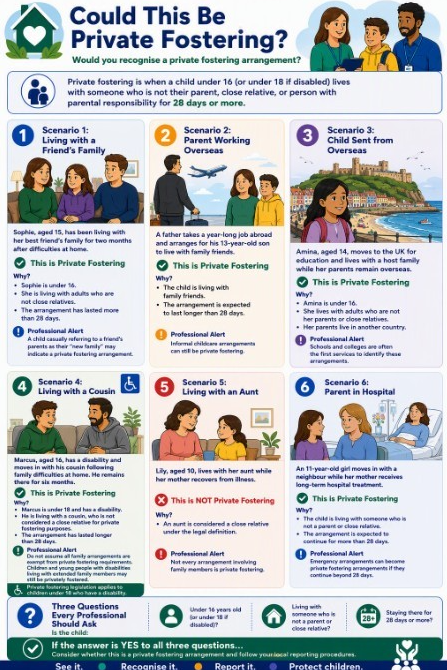
Private Fostering is when children or young person under the age of 16 years or under 18 years if they are disabled, are cared for on a full time basis by a person who is not their parent, a person with parental responsibility or a “close relative” for 28 days or more. Close relatives are defined as:
- Grandparents
- Brothers and sisters
- Uncles and aunts, or
- Step-parents (if married to the partner or in civil partnership)
A parent’s unmarried partner is not a step-parent in this context.
- Private Fostering arrangements are those where it is intended for the placement to last 28 days or more. They are generally made with the agreement of the child’s parent, but this may not necessarily be the case.
- A large range of children can be covered by these arrangements, including:
- Children, sometimes very young, where a parent is unable to care for them because of chronic ill health, alcohol or drug use, mental health issues, or because the parent is in prison.
- Adolescents temporarily estranged from their parents.
- Living with family friend due to family crisis.
- Refugee and homeless children.
- Children in service families where parents are posted overseas.
- Children from overseas where parents are not resident in this country
- Children from abroad who attend a language school or mainstream school in England, staying with host families.
The statutory responsibility for Private Fostering lies with the Local Authority, North Yorkshire Council’s Children and Young People’s Service. The Group Manager in the Children and Families Service has been appointed as the Responsible Officer for Private Fostering.
The Chair of the North Yorkshire Safeguarding Children Partnership will receive a report from the Local Authority every year about how the welfare of privately fostered children is safeguarded and promoted, including how they cooperate with other agencies in this area.
International Aspects
Any person who has limited permission to enter or remain in the United Kingdom must ensure that they comply with the conditions of that permission and make any necessary applications before it expires. Failure to maintain lawful immigration status may affect a person’s entitlement to remain in the United Kingdom and access certain services. Practitioners should seek advice from UK Visas and Immigration (UKVI) or appropriate legal specialists where clarification is required regarding a child’s immigration status. Child welfare and safeguarding considerations should remain paramount in all cases.
A person born in the United Kingdom prior to 1 January 1983 is a British citizen and is not therefore subject to immigration control. A child born in the United Kingdom after that date will be a British citizen if, at the time of their birth, their father or mother is a British citizen or lawfully settled in the United Kingdom. A newborn child who is found abandoned in the United Kingdom is assumed to meet the above requirements unless the contrary is shown; i.e. the child will be assumed to be a British citizen.
The Social Worker should check a privately fostered child’s passport to ensure the child’s immigration status, in particular that the child is lawfully present in the UK. This should be done on the first occasion that the child is seen following notification that a Private Fostering arrangement is in place. This simple, practical step is also an important means of confirming the child’s identity. For children who are UK citizens, it is recognised that they may not hold a passport. A Local Authority or Private Foster Carer who is in any doubt about a child’s immigration or nationality status should be advised to consult UK Visas and Immigration (UKVI).
This advice should be sought at the earliest opportunity. The Local Authority can also seek assistance from the authorities in the country of origin or the International Social Service (ISS) with a view to tracing the child’s parents and arranging for the child to be returned to them. In most cases, the ISS is able to provide for the exchange of medical and educational histories of a child, as well as to ascertain whether there would be any reasonable grounds not to return the child to their parents and whether parental responsibility has been terminated or circumscribed by any overseas authority, or to make arrangements for the reunification of the child with their parents overseas.
Immigration Status and Access to Education
Children of compulsory school age who are resident in England are entitled to access education in accordance with current legislation and Department for Education guidance. Eligibility to enter, reside and study in the United Kingdom is determined by the child’s immigration status and not solely by their nationality.
Where a privately fostered child is a foreign national, practitioners should consider whether the child has appropriate immigration status and seek advice from relevant immigration specialists or UK Visas and Immigration (UKVI) where necessary.
Any concerns regarding a child’s immigration status should not delay action required to safeguard and promote the child’s welfare. Child welfare and safeguarding remain paramount considerations in all assessments and interventions.
Entitlement to Health Service for Children from Overseas
A child from overseas who is resident in the UK lawfully and for a settled purpose may apply to register with a General Practitioner, or their parent or Private Foster Carer may do so on their behalf.
A child who is being privately fostered may or may not be chargeable for NHS hospital treatment, depending on the exact circumstances of their stay in the UK. A child who, for example, enters the UK on a visitor’s visa, but then remains beyond the validity of that visa, being privately fostered while their parents return to their home country, would not be here legally and could, therefore, be charged for NHS hospital treatment.
Making arrangements
Any parent proposing to have their child looked after by someone other than a close relative for more than 28 days, or a Private Foster Carer who is proposing to look after someone else’s child, must notify the Children and Families Service at least 6 weeks before the arrangement is due to begin or as soon as arranged if less than six weeks.
A person who proposes to accommodate a child or children at school in circumstances in which some or all of them will be treated as Private Foster children must give written notice of his or her intention to the Local Authority, stating the estimated number of children, not less than 2 weeks before the arrangements begin.
Notification should be made initially to North Yorkshire Council Customer contact centre, followed by written confirmation completed on a Universal Referral Form. The Customer contact centre’s contact details are available via this link:
This is known as a proposed arrangement. In these circumstances the Customer contact centre should be contacted in writing and the referral will be screened by the Multi Agency Screening Team and passed on to the relevant geographical social work team.
Where a Private Fostering arrangement is in existence or an emergency arrangement has been put in place, the Private Foster Carer or parent should tell the Children and Families Service within 48 hours.
The social work team will make arrangements to see the child, the child’s parents (if possible), the Private Foster Carers and other members of the Private Foster Carer’s household within 7 working days. An assessment will be made about the suitability of the proposed arrangements, including Enhanced Criminal Record Disclosure with a Barred List Check for working with children on all members of the household aged over 16 years. The assessment will be completed within 42 working days.
Limit on the number of foster children
In cases where a person is privately fostering, or proposes to foster privately, more than three children who are not siblings at any one time, then that person needs an exemption from the Local Authority.
If a Private Foster Carer exceeds the usual fostering limit or, where exempted, privately fosters a child not named in the exemption and in so doing exceeds the usual fostering limit he shall be treated as carrying on a children’s home. Any person who runs a children’s home without being registered in respect of the home under the Care Standards Act 2000 is guilty of an offence (see section 11 of that Act).
Where arrangements are suitable
Where the decision is taken that the arrangements are suitable a Social Worker will visit the child every 6 weeks during the first year and then every 12 weeks thereafter.
The Social Worker should make sure the child’s racial, cultural, linguistic and religious needs are being met. The Social Worker should see the child alone on each visit and will write a record of each visit.
If there are any changes in circumstances the Private Foster Carer should inform the Social Worker. Likewise the Private Foster Carer or parent (person with parental responsibility) must notify the Children and Families Service immediately about any change in circumstances, including if the child changes address, someone living in the household is convicted of an offence, or someone joins or leaves the household.
Notification of change of circumstances
A Private Foster Carer must notify the Local Authority of:
- Any change of their address
- Any further offence of which they or any person who is part of or employed at their household has been convicted
- Any further disqualification imposed on them or a person who is part of or employed at their household under section 68 of the Children Act 1989
- Any person who begins to be part of or employed at their household, and any offence of which that person has been convicted, and any disqualification or prohibition imposed on him under section 68 or 69 of the Children Act 1989 or under any previous enactment of either of those sections; and
- Any person who ceases to be part of or employed at their household.
The requirement to notify of the change of circumstances exists for the duration of the Private Fostering arrangement.
Notification must be given in advance where practicable and not more than 48 hours after the change of circumstances.
If the Private Foster Carer’s new address is in the area of another Local Authority, or the Local Authority is in Scotland, Wales or Northern Ireland, the Local Authority will pass on to the authority for the area:
- The name and new address of the Private Foster Carer
- The name of the child who is being fostered privately; and
- The name and address of the child’s parents or any other person who has parental responsibility for the child
The parent of a privately fostered child, and any other person who has parental responsibility for the child, who knows that the child is being fostered privately, must notify the Local Authority of any change of their own address.
Where arrangements are suitable with prohibitions
The role of the Local Authority is to ensure suitable arrangements are in place to promote the safeguarding and welfare of privately fostered children, and to prevent unsuitable persons privately fostering a child in premises that would not safeguard and promote the child’s welfare.
In some circumstances, the placement of a child may not be suitable or may be suitable with modifications. Where North Yorkshire Council carries out an assessment and identifies that a placement would be suitable with modifications, they may impose a prohibition on that person.
Any prohibition must be sent in writing to the person on whom it is being imposed, specifying the reasons and containing information about the person’s right of appeal and the time in which they may do so.
Cancellation of prohibitions
North Yorkshire Council may cancel a prohibition if they are satisfied that the prohibition is no longer justified. This power enables the Local Authority to respond appropriately to matters raised during the process of conducting enquiries into:
- The capacity of the proposed or actual Private Foster Carer to look after the child
- The suitability of their household and premises; or
- To changes notified by that person
Where arrangements are not suitable
Where the assessment identifies that the Private Fostering arrangements are not suitable, the Children and Families Service has a number of powers, in addition to their existing powers, to take action to safeguard and promote the child’s welfare. Steps may need to be taken to secure the care and accommodation of the child. Actions can include preventing someone from privately fostering children or setting limits on the number of children/young people being privately fostered at any one time.
Unless it is identified that it would not be in the best interest of the child who is, or is proposed to be, privately fostered, the Local Authority will take such steps that are reasonably practicable to secure the care and accommodation of the child undertaken by:
- Their parent(s)
- Any person who is not a parent but who has parental responsibility for the child/young person, or
- Is a relative
- The Local Authority will consider the extent to which, if at all, they should exercise any of their functions in respect of the child.
Appeals
Where the Local Authority makes a decision to:
- Impose a requirement or prohibition,
- Refuse to cancel a prohibition,
- Refuse to exempt a person from the fostering limit of 3 under Schedule 7 (or impose a condition on an exemption or a variation or cancellation of such an exemption), or
- Refuse to consent to allow a person who is disqualified to privately foster a child,
An appeal may be made to the family proceedings court within 14 days of notification of that decision.
The roles of other professionals
Safeguarding children who are privately fostered is broader than a Social Care function and cuts across all parts of the Local Authority, health economy, district councils and the voluntary, border agencies and private sectors. Wherever professionals become aware of an existing or proposed Private Fostering arrangement they should encourage the child’s parent or Private Foster Carer to notify the Children and Families Service.
Professionals who come into contact with privately fostered children, such as teachers, religious leaders, doctors and health visitors, are required to tell the Children and Families Service about the Private Fostering arrangement so that the Children and Families Service can carry out their duty to safeguard the child. Professionals should refer the privately fostered child through the Customer Contact Centre.
All Private Foster carers will be allocated a Social Worker from the Fostering Service to support the Private Foster Carers as well as a Social Worker for the child.
Notification of the end of a Private Fostering arrangement
Any person who ceases to privately foster a child must notify the appropriate Local Authority within 48 hours and must include in the notification the name and address of the person into whose care the child was received and that person’s relationship with the child. The requirement to notify the Local Authority of the cessation of the arrangement does not apply where the Private Foster Carer intends to resume the Private Fostering arrangement after an interval of not more than 27 days unless:
- They subsequently abandon their intention; or
- The interval expires without having given effect to their intention.
In such circumstances the Private Foster Carer must notify the Local Authority within 48 hours of abandoning their intention to continue the arrangement, or the expiry of the interval.
Death of a child who is privately fostered
Where a person ceases to privately foster a child because of the death of the child, they must notify the Local Authority within 48 hours.
The Local Authority will ensure that the parent is notified as soon as possible of the death of the child. The Local Authority may need to assist the Private Foster Carer with the formalities and, in any event, will need to consider the implications of what has happened. Where a child has died, the Local Authority must follow the Child Death procedures outlined within the North Yorkshire Safeguarding Children Partnership’s procedures.
Further information and procedures
For further information in relation to Private Fostering please see the North Yorkshire Council website at the following address:
http://www.northyorks.gov.uk/privatefostering
| Standard | Criteria | |
| 1. | Notification to the Customer contact centre of proposed arrangement by parent/Private Foster Carer | Child looked after by someone other than a close relative for more than 28 days Private Foster Carer who is proposing to look after someone else’s child who is not a close relative A written notification should be made to the Customer contact centre at least 6 weeks before the arrangement is due to begin |
| 2. | Notification to the Customer contact centre of existing arrangement or emergency arrangement | Child looked after by someone other than a close relative for more than 28 daysPrivate Foster Carer who is looking after someone else’s child who is not a close relative The parents/Private Foster Carer should notify the Customer Contact Centre within 48 hours of learning an arrangement is currently taking place. |
| 3. | Notification to the Customer contact centre by professionals | Professionals should encourage the child’s parent and/or Private Foster Carers to notify the Children and Families Service about planned or existing arrangements.Professionals who come into contact with children, like teachers, health staff or Children’s Centre workers – must tell the Children and Families Service about all Private Fostering arrangements they are made aware of.Professionals should notify the parent and/or private foster carer of their actions in notifying Local Authority. |
| 4. | Private Fostering and Residential Settings | If a child is intending to remain in a residential setting outside of term time for more than 14 days, this becomes a Private Fostering arrangement Residential settings must notify the Children and Families Service not less than 2 weeks before arrangements begin when it is known that a child will remain resident outside of term time for more than 14 days |
| 5. | Assessment of arrangements | A Social Worker should visit within 7 working days to see:the child,the child’s parents (if possible),the Private Foster Carers, andother members of the Private Foster Carer’s householdAssessment will be made about the suitability of the arrangements within 42 working daysDBS checks on all members of the household aged 16 or over |
| 6. | Private Fostering Arrangement Suitable | A fostering Social Worker is allocated to support the Private Fostering Carers and will maintain a case recordSocial Worker will visit the child every 6 weeks during the first year and then every 12 weeks thereafterSocial Worker’s role is to:to promote the welfare of the child and to check that the arrangements are still suitableThe Social Worker should see the child alone on each visit and will write a record of each visitThe Social Worker should make sure the child’s racial, cultural, linguistic and religious needs are being met. |
| 7. | Changes in Circumstances | The Private Foster Carer or parent (person with parental responsibility) should notify the Children and Families Service immediately about any change in circumstances, including: if the child changes addresssomeone living in the household is convicted of an offenceor someone joins or leaves the householdThe Social Worker needs to make sure that the child continues to be looked after properlyPrivate Foster Carers can be disqualified from privately fostering a child if:they have been convicted of any offence involving a childthey have had a child removed from their care by a court or Local Authoritythey have had their registration as a child- minder refused or cancelledthey have been prohibited from privately fostering a child orthey have been disqualified from acting as a Foster Carer |
| 8. | Private Fostering Arrangements Unsuitable | The Children and Families Service has a numberof powers, in addition to their existing powers, to take action to safeguard and promote the child’s welfare.Action may need to be taken to secure the care and accommodation of the child.Action can include:Stopping someone from privately fostering childrenSetting limits to how Private Fosterers care for childrenSome people are not allowed to becomePrivate Foster Carers ando Others can be prohibited if they are not seen as suitable carers. |
| 9. | Impose Requirements or Limitations | The Children and Families Service can impose requirements on Private Foster Carers including limiting the number of children who can be privately fostered (this should normally be no more than 3) and the standard of accommodationWhere a person is privately fostering, or proposes to foster privately, more than three childrenwho are not siblings at any one time, then that person needs an exemption from the Local AuthorityIf a Private Foster Carer exceeds the usual fostering limit or, where exempted, privately fosters a child not named in the exemption and inso doing exceeds the usual fostering limit he shallbe treated as a children’s home. |
| 10. | Prohibition of arrangements | The Children and Families Service has the power to prohibit a person from privately fostering where:a child is at riskthat person is not suitable,the accommodation is not suitablethe child’s welfare would be harmedsomeone has been convicted for offences against children orthe care of the child is unsatisfactoryAny prohibition must be made in writing, specifying the reasons and contain information about the person’s right of appeal and time in which to do soThe Local Authority may cancel a prohibition if they are satisfied that it is no longer justifiedThis enables the Local Authority to respond appropriately to matters raised during the process of conducting enquiries into:the capacity of the proposed or actual Private Foster Carer to look after the childthe suitability of their household and premises; orto changes notified by that person |
| 11. | Right of appeal | The Private Foster Carer does have the right of appeal to the Family Proceedings Court within 14 days |
| 12. | Death of a child who is privately fostered | Where a person ceases to privately foster a child because of the death of the child, they must notify the Local Authority within 48 hours The Local Authority will ensure that the parent isnotified as soon as possible of the death of the childThe Local Authority may need to assist the Private Foster Carer with the formalities and in any event will need to consider the implications of what has happenedThe Local Authority must follow the Child Deathprocedures outlined within the North Yorkshire Safeguarding Children Partnership procedures |
| 13. | Notification of the End of a Private Fostering arrangement | Any person who ceases to privately foster a child must notify the appropriate Local Authority within 48 hoursNotification must include:the name and address of the person into whose care the child was received, andthat person’s relationship with the childThe requirement to notify the Local Authority of the cessation of the arrangement does not apply where the Private Foster Carer intends to resume the Private Fostering arrangement after an interval of not more than 27 days unless: they subsequently abandon their intention; orthe interval expires without his having given effect to his intention,In such circumstances the Private Foster Carer must notify the Local Authority within 48 hours of abandoning their intention to continue the arrangement, or the expiry of the interval. |
Further Information:
NYSCP Notification of Fostering _OMG
Could This Be Private Fostering?
Page Reviewed – July 2026


 View all our news