
Submitting a referral to the National Referral Mechanism (NRM) for a child
What is the National Referral Mechanism (NRM)?
The National Referral Mechanism (NRM) is the national framework for identifying and referring potential victims of modern slavery and human trafficking and ensuring they receive appropriate safeguarding and support.
Children may experience different forms of modern slavery and trafficking, including criminal exploitation, sexual exploitation, forced labour and other forms of exploitation.
The Single Competent Authority (SCA), which is part of the Home Office, has responsibility for the administration of the NRM nationally. North Yorkshire and City of York currently participate in devolved decision-making arrangements for children, meaning that decisions for children who are within scope of the pilot are made locally through a multi-agency NRM panel.
The NRM runs alongside established safeguarding processes and does not replace them. Safeguarding, protection and disruption activity should not be delayed while an NRM referral or decision is being considered.
What is a ‘First Responder?’
The people and organisations authorised to make referrals to the NRM are known as First Responders. A number of statutory and non-statutory organisations are designated as First Responder Organisations.
NRM referrals are formally submitted through the Home Office digital referral service by an authorised First Responder.
If you are not a First Responder but have concerns that a child may be experiencing modern slavery or trafficking, you can still report modern slavery via the helpline on 0800 0121 700 or report it online via the Modern Slavery Helpline
A child’s consent is not required for an NRM referral. However, the process should be explained to the child in an age-appropriate and accessible way, taking account of their communication needs and individual circumstances. Their views, wishes and feelings should be heard and recorded.
When do I notify the Home Office?
An NRM referral should be considered where there are reasonable grounds to believe that a child may be a victim of modern slavery or human trafficking.
A child does not need to make a disclosure or identify themselves as being exploited before a referral can be considered.
Practitioners should consider all available information, including the child’s circumstances, vulnerabilities, behaviour and presentation, indicators of exploitation and relevant information from partner agencies.
Children affected by exploitation may minimise or deny what has happened, provide information gradually, continue to have contact with those who may be exploiting them, or provide accounts containing gaps or inconsistencies. These factors should be considered in the context of the child’s age and development and the potential impact of grooming, coercion, fear, dependency and trauma.
There are two elements to consider:
- The fact that you may have encountered a victim of Modern Slavery is a LOW threshold. You do not need to know, believe or have any evidence; suspicion alone will suffice.
- Modern Slavery is a serious safeguarding concern and criminal offence, and children affected may have suffered or be at risk of significant harm. The information provided within an NRM referral should therefore clearly explain the concerns, relevant indicators, the child’s circumstances and the information supporting the professional assessment.
- Where further exploitation, a new perpetrator or a different form of exploitation is identified for a child who already has an NRM referral, practitioners should contact the NRM Coordinator. Advice can then be provided about whether the information should be added to the existing NRM referral or whether a further referral is required under the current Home Office process.
How do I notify the Home Office?
North Yorkshire and City of York are participating in devolved decision-making arrangements for children. This means that decisions about whether a child within scope has been subjected to modern slavery or human trafficking are considered locally through a multi-agency NRM panel.
NRM referrals are formally submitted through the Home Office digital NRM referral service. Practitioners in North Yorkshire and City of York should follow the agreed local process and contact the NRM Coordinator for advice and support.
How do I refer a child to the NRM Panel?
If you are a first responder and you suspect you have a child who may have been a victim of modern slavery, you should speak to your manager or Specialist Social Worker and then contact the NRM Coordinator via email at NRM@northyorks.gov.uk.
The NRM Coordinator will guide you through the local referral and panel process and can provide advice about the information required to support effective NRM decision-making.
They can also provide advice regarding referral to the Independent Child Trafficking Guardianship Service (ICTG), provided through Barnardo’s, where appropriate. Further information about this service can be found here: National Counter Trafficking Centre (including Independent Child Trafficking Guardianship Service) | Barnardo’s
Consideration of support for the child should take place as early as possible and should not unnecessarily await the outcome of an NRM decision.
What is the North Yorkshire and City of York NRM Panel?
The NRM Panel is a multi-agency panel involving senior or appropriately authorised representatives from key safeguarding agencies.
Its purpose is to provide consistent, evidence-led and multi-agency decision-making about whether a child has experienced modern slavery or human trafficking, while ensuring this work remains connected to the child’s wider safeguarding and multi-agency plan.
Current Home Office guidance for devolved decision-making requires representation from the three safeguarding partners: local authority, health and police.
The panel considers all available information relating to the child and applies the definitions and decision-making requirements contained within the Modern Slavery statutory guidance and relevant Home Office guidance.
The panel will take place every fortnight on a Monday (City of York) and a Friday (North Yorkshire).
The panel may hear the information surrounding what has happened to a child at two points:
- Reasonable Grounds The first stage is the Reasonable Grounds (RG) decision. The panel considers whether there are: reasonable grounds to believe, based on all available general and specific evidence but falling short of conclusive proof, that the child is a victim of modern slavery. This is an initial evidential threshold and does not require conclusive proof. The child’s account should be considered alongside all available information, including relevant contextual and multi-agency evidence. The Home Office guidance states that a Reasonable Grounds decision should be made within five working days of referral, where possible.
- Conclusive Grounds (CG) is the second decision the panel is required to make. At this stage, the panel considers whether, on the balance of probabilities, there is sufficient information to decide that the child is a victim of modern slavery or human trafficking.
- The Home Office guidance states that a Conclusive Grounds decision should be made as soon as possible after the minimum 30-calendar-day recovery period following the Reasonable Grounds decision has passed, providing there is sufficient information available to make the decision. There is currently no national target timescale for reaching a Conclusive Grounds decision. However, locally, the North Yorkshire Panel aims to ensure that both the Reasonable Grounds and Conclusive Grounds decisions are made within 90 days of the date the referral is received from the SCA. Where further information is required, this should be obtained and considered before a final decision is reached.
*Decisions made by the panel will be subject to Quality Assurance checks by the SCA
What should I include in the NRM Referral?
An NRM referral should clearly explain what is known about the child’s circumstances, what may have happened to them, and why the available information indicates that they may have experienced modern slavery or human trafficking.
Time and care should be taken when completing the referral. The NRM Coordinator can provide support and guidance throughout the process. However, you should consider:
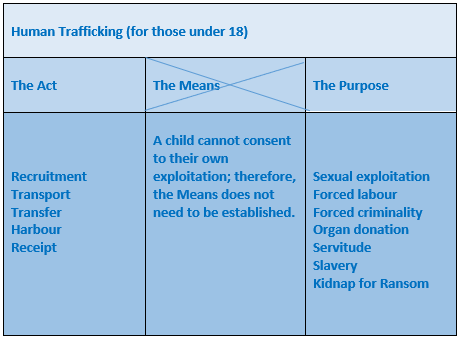
- The definition of Modern Slavery and Human Trafficking is as per the ‘Palermo Protocol’ below. This is the definition the panel will use to decide if a child is a victim of modern slavery or not.
- The child’s age and circumstances. A child cannot consent to their own exploitation. Their apparent agreement or participation should therefore be considered in the context of their age and the potential impact of grooming, coercion, threats, deception, power imbalance and dependency.
- Introduce the child and provide relevant context. Include information about the child’s circumstances and vulnerabilities where these are relevant to understanding the exploitation. Use child-centred language and avoid wording which could imply that the child is responsible for the harm they have experienced.
- Clearly articulate the concerns. Explain what is believed to have happened to the child, where and when it occurred, who may have been involved and how the child became involved.
- Provide the evidence and rationale supporting the concerns. Consider indicators of exploitation, information from police and partners, information provided by the child or third parties, relevant arrests or incidents and wider contextual information.
- Consider trafficking elements where relevant. Include evidence relating to recruitment, transportation, transfer, harbouring or receipt of the child and the purpose for which this may have occurred.
- Consider the information cumulatively. A disclosure from the child is not required. The child’s account should be considered alongside the wider evidence and contextual information available.
- Consider trauma and exploitation when assessing the child’s account. Delayed disclosure, incomplete information or inconsistencies should not automatically be taken to mean that exploitation has not occurred. Consider whether trauma, fear, grooming, developmental needs, communication difficulties or coercion may provide an explanation.
- Identify the source of information. Where possible, distinguish clearly between the child’s account, established facts, professional assessment and intelligence that has not been verified.
- Include relevant details of individuals linked to the exploitation. Accurate identifying information should be provided where it is necessary and proportionate to support safeguarding, assessment, disruption or investigation.
- Explain the safeguarding response. Include relevant action already being undertaken to safeguard the child, reduce risk and disrupt those who may be causing harm.
What does the outcome of the NRM mean for a child/young person?
Stage 1 – The Reasonable Grounds decision:
A positive Reasonable Grounds decision means that the panel has determined that there are reasonable grounds to believe, based on the available evidence but falling short of conclusive proof, that the child is a victim of modern slavery or human trafficking.
A positive Reasonable Grounds decision allows the NRM process to proceed to consideration of a Conclusive Grounds decision and provides formal recognition of the concerns at this initial stage.
Relevant information may also be shared with the police to inform consideration of crime recording, safeguarding, disruption and investigative activity. An NRM decision is separate from any criminal investigation or prosecution and applies a different decision-making test.
Remember: the NRM runs alongside established safeguarding processes; it does not replace them.
Safeguarding and protective action should therefore continue according to the child’s needs and should not wait for the outcome of the NRM process.
Stage 2 – Conclusive Grounds Decision:
A Conclusive Grounds decision considers whether, on the balance of probabilities, there is sufficient information to decide that the child is a victim of modern slavery or human trafficking.
A positive Conclusive Grounds decision provides formal recognition, for the purposes of the NRM, that the child has been identified as a victim of modern slavery or human trafficking in relation to the exploitation considered within the decision.
The decision does not determine the criminal guilt of another individual and does not replace ongoing safeguarding, child protection or disruption planning.
Where a child is suspected of committing offences which may be connected to their exploitation, professionals should consider the potential relevance of section 45 of the Modern Slavery Act 2015 and ensure that information concerning the child’s exploitation is appropriately shared with criminal justice partners.
A more comprehensive guide can be accessed through the existing City of York and North Yorkshire Modern Slavery and Human Trafficking Toolkit
Page Reviewed: November 2026

 View all our news