

Out of Area Looked After Children Protocol
1. Purpose
This protocol sets out the multi-agency arrangements for safeguarding and promoting the welfare of children who are looked after by another local authority and placed within North Yorkshire, or placed by North Yorkshire Council outside of its area.
It provides clarity on:
- statutory responsibilities
- expectations for planning and decision-making
- notification and information-sharing requirements
- multi-agency working arrangements to safeguard children
This protocol supports compliance with:
- Children Act 1989 and associated regulations (Care Planning, Placement and Case Review)
- Regional protocol for children moving across local authority borders
North Yorkshire Context:
North Yorkshire is England’s largest rural county. Across the county, there are a number of large towns, but the majority of the county’s schools are in rural areas centred on market towns.
The Council website can be accessed here: www.northyorks.gov.uk
There are a number of looked-after children placed in North Yorkshire by other local authorities. North Yorkshire Council (NYC) would like to notify you about key contacts, resources and facilities available to Looked after Children and young people placed in the county.
Key Principles:
All partners must adhere to the following principles:
- Corporate parenting responsibility remains with the placing authority at all times.
- The host authority supports safeguarding but does not assume case responsibility.
- Children’s welfare, experiences, and outcomes are central to all decisions.
- Out of authority placements must only be used where they are demonstrably in the child’s best interests.
- Planning, engagement, and information sharing must be timely, robust, and multi-agency.
- Placement decisions must be evidence-based and consistent with the child’s care and placement plans.
All agencies must ensure that children placed in North Yorkshire:
- feel safe and supported in their placement
- receive timely access to education, health, and specialist support
- maintain meaningful relationships with family and significant others where appropriate
- experience stability and continuity in care
- have their wishes and feelings actively sought and acted upon
Professionals must be able to demonstrate:
- how placements support stability, wellbeing, and permanence
- how risks associated with distance (e.g. isolation, exploitation, disruption) have been mitigated
2. Introduction to Out of Authority Looked After Children (OOALAC)
The statutory guidance for Out of Authority Looked after Children: Supplement to The Children Act 1989 Volume 2: care planning, placement and case review guidance and associated regulations strengthens the responsibilities of local authorities to notify other local authorities if they place a looked after child within their area. It also requires children’s homes to notify their host local authority when a child is placed with them by another local authority[1].
Where a child who is not looked after is placed in a health or education placement for three months or more, or with that intention, the placing authority also has a duty to notify the host local authority prior to placement or as soon as practicable thereafter.
The host local authority, supported by relevant agencies in both the host and home authority, must ensure that education and health partners are provided with information about placements of looked-after children into/out of their area. This document should be read alongside the regional protocol or children who move across Local Authority Borders
3. What North Yorkshire Council will provide
NYC will provide a “Local Offer” for Looked after Children who are placed within North Yorkshire. This includes the contact details and arrangements for universal, targeted and specialist services available and key contacts within North Yorkshire.
The NYC Local Offer can be accessed here: http://cyps.northyorks.gov.uk/local-offer-looked-after-children
When North Yorkshire Council places children outside of their local authority it is expected that staff will follow the steps outlined in this protocol and liaise with the host authority to identify any local variations.
Role of the Host Authority (North Yorkshire)
North Yorkshire Council will:
- provide safeguarding intelligence and contextual risk information
- contribute to placement planning through consultation
- support multi-agency coordination
- respond to safeguarding concerns (including Section 47 enquiries)
- convene and host strategy discussions where required
- share information with relevant partners (Police, Health, Education)
Voice of the child:
The placing authority must ensure that the child’s wishes, feelings, and lived experience are central to all placement decisions, care planning, and safeguarding activity.
This includes:
- actively seeking and recording the child’s views before placement wherever possible
- ensuring the child understands the reason for the placement and what to expect
- taking account of the child’s views in decisions about location, education, and support
- ensuring the child knows who to speak to if they feel unsafe or unhappy
- supporting ongoing communication between the child and their social worker, Independent Reviewing Officer (IRO), and other trusted adults
Where a child is unable to express their wishes directly, professionals must ensure that their views are understood through advocacy, observation, and engagement with those who know them well.
Evidence of the child’s voice, and how it has influenced decisions, must be clearly recorded in the child’s care and placement plans.
For further information and guidance please access the NYSCP Voice of the Child Toolkit NYSCP
4. Duty to consult and notify
There will be circumstances where a distant placement will be the most suitable for a child, such as where the child concerned has complex treatment needs that cannot be met by services within the area of the responsible authority. There will also be children who require an out-of-authority placement to ensure they can be effectively safeguarded. Such placements will require effective planning, engagement and information sharing with the services likely to be responsible for meeting the child’s needs in the future.
The responsible authority must clearly evidence why the proposed placement is the most appropriate option for the child, including consideration of proximity to home, maintaining relationships, and the impact on the child’s stability and wellbeing.Regulation 11 requires the responsible authority to consult with the host local authority when they are considering making a distant placement, this needs to be in good time to enable a thorough assessment of appropriateness[1]. The child’s named Independent Reviewing Officer (IRO) must be consulted before any final decision is made about making an out-of-authority placement, whether distant or not, to enable the IRO to discuss the proposed arrangements with the child and, where appropriate, the child’s relatives or parents. Where a responsible authority is considering a placement in a residential children’s home, it should take into account the information in the home’s Statement of Purpose.
Where a placement is commissioned from an external provider, the responsible authority must ensure that appropriate commissioning, procurement and contract management arrangements are in place before the placement is confirmed, except in emergency circumstances where this must be completed as soon as practicable.
The placing authority remains responsible for ensuring that the placement is lawful, suitable, affordable and capable of meeting the child’s assessed needs. This includes ensuring that the correct contractual route is used, that provider due diligence has been completed, and that the cost and content of the placement are clearly agreed and recorded.
Before confirming a placement, the responsible authority should consider:
- the provider’s registration status, regulatory history and any known safeguarding or quality concerns;
- whether the placement is consistent with the child’s care plan, placement plan and assessed needs;
- whether the provider can evidence appropriate staffing, training, safeguarding arrangements and management oversight;
- the agreed cost of the placement, including any additional staffing, education, therapy or transport costs;
- the notice period, review arrangements, reporting requirements and escalation route;
- whether the placement represents value for money in the context of the child’s needs and available alternatives.
Where North Yorkshire Council is the host authority, it may share relevant local safeguarding intelligence and contextual risk information to support placement decision-making. This does not transfer commissioning, contracting or case management responsibility from the placing authority.
Where North Yorkshire Council commissions a placement outside of its area, the relevant commissioning and contract management arrangements must be followed to ensure provider performance, quality, cost and contractual compliance are monitored throughout the duration of the placement.
North Yorkshire’s Multi Agency Screening Team (MAST) will provide local information and intelligence around the potential placement, seek information from Police, Health and Local Authority Partners (including Local Authority Designated Officer (LADO) within the Multi Agency Screening Team. This does not mean they will veto over the responsible authority’s placement decisions but allow local discussion and information sharing and consideration for contextual safeguarding concerns to take place via the Multi-Agency Screening Team. It is important to allow enough time to share information prior to the placement being finalised. To speak directly with the Multi Agency Screening Team, phone or email social.care@northyorks.gov.uk.
Safeguarding and Risk Management:
Placement planning must explicitly consider:
- risk of exploitation (including CSE/CCE)
- risk of going missing
- contextual safeguarding risks in the local area
- suitability of the placement location
Where concerns arise:
- referrals must be made to MAST (worried about a child)
- strategy discussions will be convened where appropriate
- information must be shared with the placing authority without delay
There may be occasions when an Out of Authority Looked After Child experiences significant harm while resident in North Yorkshire. On such occasions, a referral to the Multi -Agency Screening Team (MAST) should be made as per the “worried about a child” guidance. MAST will establish the circumstances of the incident, including the whereabouts in North Yorkshire the incident has occurred, and MAST will liaise with the relevant partners North Yorkshire Local Authority will convene and host a Strategy Meeting as per statutory timescales inviting the placing Local Authority. North Yorkshire will not assume case responsibility but will ensure that all relevant partnership information is shared with the responsible authority.
[1] The Children’s Homes and Looked After Children (Miscellaneous Amendments) (England) Regulations 2013 – Part 3
4.1 Health
When a Looked after Child is being placed out of area, it is the responsible authority must ensure that the child’s health needs can be met at the proposed placement.
To do this, they need to;
- Establish what the child’s health needs are and what is required to meet these needs.
- Where the child will require specialist health services such as CAMHS or other specialist paediatric services, the responsible authority should consult with the Integrated Care Board (ICB) that commissions secondary healthcare in the host area to establish whether the placement is appropriate and able to meet the child’s needs.
- Where the child has complex needs, the responsible authority can have a discussion with the Designated and Named Professionals for looked-after children in the host area authority, who will be a valuable source of advice and information.
If the child is to be accommodated in a children’s home that offers specialist health care such as therapeutic care, the responsible authority must be confident that the professional care provided will meet the assessed health needs of the individual child.
The responsible authority, as a corporate parent, should work with children’s home staff to secure the health services that each child needs. In particular, social workers and other relevant officers in the authority responsible for a looked-after child should work with the home to:
- Agree on the specific responsibilities of the home towards supporting the health needs of every child at the time the placement is made.
- Ensure that these responsibilities are recorded in the child’s placement plan. This must include recording permission from a person with parental responsibility for the child for staff to administer first aid and non-prescription medication and clearly agreed responsibilities for the administration of prescription medication.
- Be confident that staff in the home have sufficient understanding of relevant local health provision, including the functions of the Designated Doctor and Designated Nurse for Looked after Children in their area, and can support children to navigate these services, advocating on their behalf where necessary and appropriate.
- Should share the plan with the responsible ICB the host ICB and the local Named Nurse for Looked after Children to clarify that what is proposed can be provided locally.
Staff in residential settings should also support the child to register with a GP and Dentist locally and to access statutory health assessments and any medical appointments necessary to meet their identified health needs.
When a child/ young person attends for an Initial Health Assessment, they must be accompanied by a worker who has all the relevant background information to share with the paediatrician undertaking the health assessment.
The worker accompanying the young person must be aware of the importance of the health assessment, and the significance that sharing relevant information has in ensuring a meaningful and comprehensive assessment is undertaken.
Designated Nurses – Email: hnyicb-ny.safeguarding-adminteam@nhs.net
Specialist Nursing Team for Looked after Children – Tel: 01423 542367
email: ny.lacnurses@nhs.net
4.2 Education
Consideration should always be given to securing appropriate education at the same time as planning a new care placement. It is inappropriate, except in exceptional emergency circumstances, to place a child in North Yorkshire without arranging a school admission at the same time.
To contact North Yorkshire Councils, Virtual Head Tam you can email Telephone: 01609 533231 or email: virtualschool@northyorks.gov.uk
More information about the Virtual School can be accessed here: North Yorkshire Virtual School – Learning Homes and Caring Schools | CYPSinfo
4.3 Police
When notified about an out of authority looked after child moving to North Yorkshire, North Yorkshire Police will place an appropriate flag on the police records management system, Niche. If a public protection notice (PPN) is completed by a member of North Yorkshire Police for an OOALAC this will be shared with the child’s home police force who will then share it the responsible local authority.
4.4 Notification
Following the initial consultation with relevant local services and prior to the looked after child being placed in North Yorkshire, the North Yorkshire Council out of Authority Looked after Children notification form must be used for all notifications of Looked after Children to be placed in North Yorkshire. Once completed, this should be sent to ooalac@northyorks.gov.uk. Notifications must highlight any specific risks or vulnerabilities to assist services in North Yorkshire to respond effectively.
It is also particularly important that changes of address and notifications of all Looked after Children leaving North Yorkshire should also be sent to ooalac@northyorks.gov.uk to ensure accurate records can be maintained.
If you need to contact North Yorkshire Council, Children and Families Team, please call the Customer Resolutions Centre on 0300 131 2 131 or for emergencies outside of office hours, call the Emergency Duty Team on 0300 131 2 131. Email contact can be made via social.care@northyorks.gov.uk.
4.5 Notification Internal Process
Once a notification form is received by North Yorkshire Council’s, Safeguarding Unit via ooalac@northyorks.gov.uk the information will be shared with the following organisations for information/action.
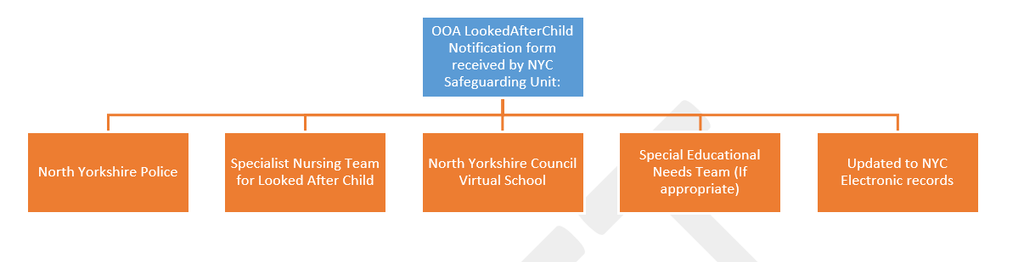
5. Emergency Placements
An emergency placement occurs only when it is necessary to place a child without notice in order to safeguard their welfare and ensure their safety. In the case of a placement made in an emergency, the responsible authority must notify North Yorkshire Council using the process as outlined in section 4. The approval of the Director of Children’s Services from the responsible authority is still required and s/he must be satisfied that the child’s wishes and feelings have been ascertained and given due consideration, and that the placement is the most appropriate placement available consistent with the Care Plan.
North Yorkshire Council expects all responsible authorities to ensure the host authority is notified verbally, either by contacting the Customer Service Centre during office hours or the emergency duty team 0300 131 2 131 out of hours.
Following an emergency placement, North Yorkshire Council require a fully completed notification form submitted within one working day of the placement move as outlined in Section 4 of this procedure.
6. Missing from Home and Care
Within North Yorkshire, there is a Missing from Home and Care Joint Protocol which has been agreed by North Yorkshire Police, North Yorkshire Council and The City of York Council, which outlines the process for dealing with Missing Children.
The Missing from Home and Care Join Protocol can be found here: NYSCP
Where an Out of Authority Looked after Child goes missing from home or care, the responsible authority has a duty of care to undertake the missing from home or care return interview within 72 hours. The return form must be sent to both North Yorkshire Police and the Safeguarding Unit via missingfromhome@northyorkshire.pnn.police.uk / ooalac@northyorks.gov.uk.
Out of Area Young People Arrested, who appear to be at risk of criminal exploitation
A joint protocol is in place for out of area young people who are arrested who appear to be at risk of criminal exploitation can be accessed here: NYSCP
7. Private Children’s Residential Home Providers
The Children’s Homes and Looked after Children (Miscellaneous Amendments) (England) Regulations 2013 introduced changes to the Children’s Homes Regulations 2001 and the Registration Regulations. Regulation 31(1A) and (1B) of the Children’s Homes Regulations 2001 introduced a requirement for providers or managers to ensure that premises used for the purposes of a children’s home are appropriately and suitably located so that children cared for by the home are:
- effectively safeguarded, and
- able to access services to meet the needs identified in their care or placement plans
Where an Out of Authority Looked after Child is accepted for placement within a Private Residential Children’s Home in North Yorkshire, we ask that the Registered Manager notify North Yorkshire Council by sharing the Out of Area Looked after Children Notification Form which should be sent to ooalac@northyorks.gov.uk without delay in accordance with Regulation 41.[1]
To assist with quality assurance of Out of Area Looked After Children North Yorkshire Council require the Registered Manager to provide a monthly Admission and Discharge list which should be sent to ooalac@northyorks.gov.uk at the end of each calendar month.
North Yorkshire’s Council Planning Departments will notify the North Yorkshire Safeguarding Children Partnership via nyscp@northyorks.gov.uk of all new planning applications for a private residential children’s home, and new providers will be approached by the North Yorkshire Safeguarding Children Partnership with a view to signing up to this protocol and supporting procedures.
North Yorkshire Council Planning Departments will notify the North Yorkshire Safeguarding Children Partnership via nyscp@northyorks.gov.uk of all new planning applications for private residential children’s homes. New providers will be approached by the North Yorkshire Safeguarding Children Partnership with a view to signing up to this protocol and supporting procedures.
Where a new application is received, the North Yorkshire Safeguarding Children Partnership will coordinate consideration of any relevant safeguarding information and provide advice, where appropriate, to support the Planning Department’s decision-making process.
[1] The Children’s Homes (England) Regulations 2015
8. Information Sharing Arrangements
The North Yorkshire Safeguarding Children Partnership recognise the importance of effective information sharing arrangements between placing local authorities, residential settings and local safeguarding partners in order to ensure that all children in North Yorkshire are safe.
All North Yorkshire Safeguarding Children Partnership partners are committed to sharing relevant information with the placing local authority and residential setting in order to support them in discharging their legal duties. However, to do so, the placing local authority and residential setting need to ensure that robust information-sharing arrangements are in place.
When a child is placed in a private residential setting within North Yorkshire, there is an expectation that the placing responsible authority will ensure that the child’s Care and Placement Plans include arrangements for the dissemination and collation of relevant safeguarding information to and from North Yorkshire Safeguarding Children Partnership partners within North Yorkshire. This is to ensure that local partners can effectively contribute to the safeguarding of the child whilst placed in North Yorkshire.
Placing responsible authorities and/or residential settings should contact the North Yorkshire’s Multi Agency Screening Team to discuss urgent safeguarding concerns by either speaking directly with the Multi Agency Screening Team via phone 0300 131 2 131 or email social.care@northyorks.gov.uk, or alternatively out of hours using the Emergency Duty Team 0300 131 2 131 or email EDT@northyorks.gov.uk.
Residential Children’s Homes and Foster Carers need to ensure they work with the responsible authorities to ensure information is appropriately shared to safeguard the children in their care.
Registered Managers are invited to attend the Multi-Agency Child Exploitation (MACE) and Contextual Safeguarding Practitioner Group Level 2 within their locality. MACE Level 2 meetings discuss perpetrators, areas of concern, contextual safeguarding concerns and community intelligence with the aim to work together and disrupt exploitation. To be added to the attendance list or to speak with the Chair, we ask that contact is made via MACE@northyorks.gov.uk Additional detail regarding MACE and Contextual Safeguarding can be found NYSCP
All requests for North Yorkshire Safeguarding Children Partnership information required by Registered Managers for Safe Area Reports under Regulation 46 are required to be sent to nyscp@northyorks.gov.uk in order that these can be coordinated by North Yorkshire Safeguarding Children Partnership partners. The requests will be the subject of discussion at the local MACE Level 2 meeting in order to provide an appropriate and meaningful response. The reviews should consider the following:
- whether the location of a home represents a risk that children will be targeted for sexual exploitation.
- whether the location of the home influences the potential that a vulnerable child could be a victim of violent crime.
- whether there is a likelihood of children becoming drawn into gang crime or anti-social behaviour in the local area.
- the appropriateness of the local neighbourhood as a location to care for vulnerable children with experiences of trauma, abuse and neglect.
All Out of Authority Looked after Children remain the responsibility of the placing Local Authority. Any local North Yorkshire Safeguarding Children Partnership partner with information relating to a safeguarding concern or risk to any specific out-of-area placed child or children should notify the relevant responsible authority for that child without delay. The information should also be shared with the North Yorkshire Multi-Agency Screening Team in order that local risk determination can take place.
Out of Area Looked After Child Group
The OOALAC Group provides multi-agency oversight of children placed within North Yorkshire.
Its role includes:
- ensuring accurate information is shared across agencies
- identifying emerging risks and themes
- supporting safeguarding coordination
- informing partnership learning and improvement
The Out of Area Looked after Child Group (OOLAC Group) meets on a fortnightly basis and is vital in collating information about young people placed within North Yorkshire Council’s boundaries. OOLAC Group ensures information from placing authorities is shared with North Yorkshire Children and Families Service, Primary Care and Education, ensuring the child’s access to services under the NYC Local Offer is recorded. The Out of Area Looked after Child Group (OOLAC Group) does not case manage young people placed from other local authorities and is solely a group to ensure the correct information is recorded on NYC multi-agency systems.
9. Escalation Process
Any professional who has concerns regarding a placement provider, responsible authority or relating to the management of the setting should escalate this through their own agency child safeguarding lead, who should in turn raise this formally to the North Yorkshire Safeguarding Children Partnership Manager via nyscp@northyorks.gov.uk or by calling 0300 131 2 131.
If a partner agency identifies significant concerns regarding a provider, concerns must be raised without delay to Ofsted as the regulator. It is important to note that if there is a concern relating to the welfare or safety of a child, this should be referred to the Customer Resolution Centre directly here.
To effectively manage concerns that have been raised to North Yorkshire Safeguarding Children Partnership with regards to Out of Authority Looked after Children the escalation process below will be followed.
Escalation Process: NYSCP
10. Definitions
| Subject | Definition |
| Out of Authority | This is any placement not in the local authority’s geographical boundaries. These will be placements in local authorities which have a geographical boundary with the home local authority |
| At a Distance | This is any placement not in the local authority’s boundaries and also not within any of the bordering local authorities. Distance such as 20 miles from the local authority no longer applies and should not be used. |
| Looked After Children | A child is ‘looked after’ if they are in the care of the local authority for more than 24 hours |
| NYSCP | North Yorkshire Safeguarding Children Partnership www.safeguardingchildren.co.uk |
| Host authority | The local authority for the area in which the child is placed or is to be placed where this is different from the responsible authority. |
| Nominated officer | A senior officer of the responsible authority, nominated in writing by the Director of Children’s Services, for the purposes of approving placement decisions made under the Care Planning Regulations. |
| Placement provider | A foster carer; registered person for a children’s home; or the person responsible for the child’s accommodation where they are placed in other arrangements. Connected persons may also be placement providers, as are parents, if the child is placed under Part 4, Chapter 1 of the Care Planning Regulations. |
| Responsible authority | The local authority which looks after the child. |
11. Useful Links
MACE and Contextual Safeguarding Practice Guidance – MACE and Contextual Safeguarding Practice Guidance
NYP Partnership Intelligence Sharing Portal – NYSCP
Worried about a child & online referral form: NYSCP
OOALAC Notification Form – Out of Area Looked after Children Notification Form
Review and Monitoring
This protocol is reviewed periodically in line with national and local guidance, through the NYSCP Practice and Learning Subgroup.
Page reviewed: October 2026


 View all our news